
TV Disposal

Business, hotel and landlord TV collections

Bulk TV and monitor collections for hotels, offices, student lets and rental properties in the UK, with waste transfer paperwork for business customers.

In short: Business, hotel and landlord collections remove TVs and monitors in bulk from hotels, offices, student accommodation and rental properties, with waste paperwork provided so businesses can meet their duty of care. It suits refurbishments, upgrades and end-of-tenancy clearances. Bulk collections are usually priced by volume, often around £10 to £30 per unit depending on type, quantity and access.

Get a free quote

Fixed price, no obligation. We aim to reply the same day.

By sending this form you agree to be contacted about your enquiry. See our privacy policy.

Business, hotel and landlord TV collections

Businesses replace TVs and monitors in batches. A hotel refurbishment can mean dozens of room TVs coming off the wall at once, an office upgrade leaves stacks of old monitors, and student lets and rental portfolios accumulate sets left behind or replaced between tenancies. Business waste rules are stricter than household rules: under the duty of care in section 34 of the Environmental Protection Act 1990, a business must make sure its waste is passed only to an authorised person and must keep records of the transfer.

A business collection is planned around access and timing, such as working floor by floor in a hotel or clearing a block of flats between lets. TVs and monitors are taken down where needed, loaded and taken to permitted WEEE facilities. Waste transfer notes or, where waste is hazardous, consignment notes are provided. Many older screens, such as CRT monitors and LCDs with fluorescent backlights, are classed as hazardous waste.

What is included

  • Bulk collection of TVs, monitors and screens from any number of rooms
  • Wall-mounted TV and bracket removal across multiple rooms
  • Work planned around guests, staff, tenants or site hours
  • Waste transfer notes, or consignment notes for hazardous waste
  • Collection of related electricals such as set-top boxes, hotel TV systems and AV kit
  • Transport to permitted WEEE treatment facilities
  • Repeat collections for ongoing upgrades or portfolio turnover

Who it is for

  • Hotels and holiday parks replacing room TVs
  • Offices and co-working spaces upgrading monitors and meeting room screens
  • Student accommodation and HMO landlords
  • Letting agents clearing items between tenancies
  • Schools, care homes, pubs and gyms replacing screens

How much does it cost?

As a guide, bulk TV and monitor collections are usually priced by volume, commonly around £10 to £30 per unit depending on size, type and access, with wall-mount removals and hazardous screens such as CRTs at the higher end. See our full cost guide.
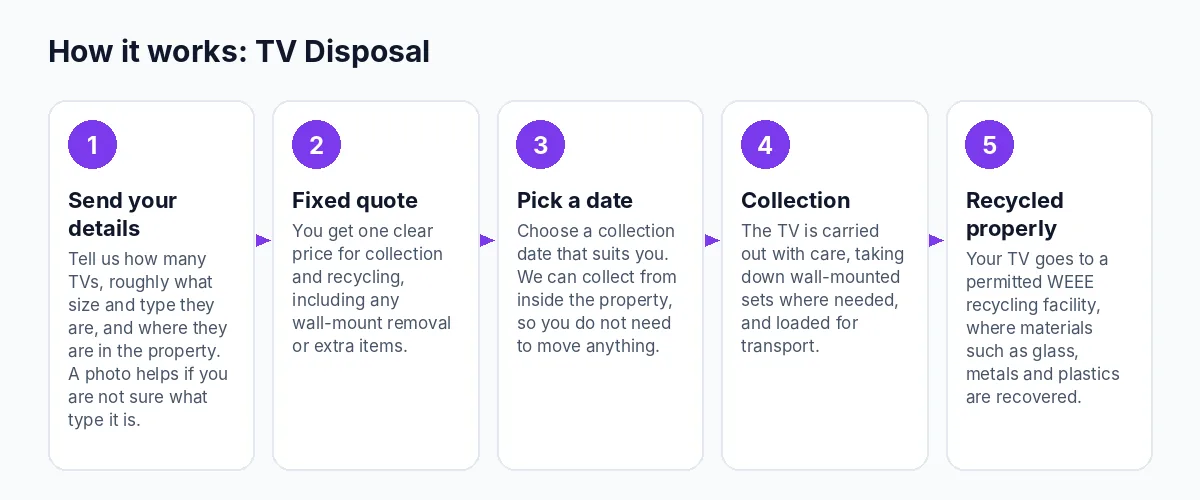
How it works

How business, hotel and landlord tv collections works, step by step
  1. Scope the job

    Share the number and types of TVs and monitors, the locations and whether any are wall mounted.

  2. Plan access

    Timing, parking, lifts, loading areas and any site rules are agreed in advance.

  3. Collect

    Screens are removed and loaded efficiently, floor by floor or property by property.

  4. Paperwork

    Waste transfer notes or consignment notes are provided so you can keep the records the law requires.

Business, hotel and landlord TV collections: FAQs

What paperwork does my business need for TV disposal?

For non-hazardous waste, you need a waste transfer note describing the waste, its quantity and waste code, signed by you and the carrier, and kept for at least two years. For hazardous waste, such as CRT screens and many older flat screens, a consignment note is used instead in England and Wales and kept for three years. Scotland and Northern Ireland have similar but separate systems.

Can our staff take the TVs to the tip?

Most household waste recycling centres are for householders only, and many councils restrict or charge for business waste. A business carrying its own waste regularly may also need to register as a waste carrier. In most cases, using a registered waste carrier that takes waste to a permitted facility, and keeping the paperwork, is the simplest way to meet your duty of care.

Can the TV manufacturer take back our old screens?

Under the WEEE Regulations 2013, producers have responsibilities for financing the collection and treatment of business electrical waste, particularly when supplying new equipment that replaces old. Depending on what you are buying and from whom, your supplier may be able to arrange take-back. It is worth asking when you order new screens, but timing and terms vary.

Do landlords have to dispose of TVs left by tenants?

Items left behind by a former tenant still belong to them, so landlords in England and Wales normally need to give notice and a reasonable chance to collect them before disposing, under the Torts (Interference with Goods) Act 1977. Once that process is complete, the TV should be disposed of through a legitimate route. Keep a record of the notice and the collection paperwork.

Get a quote for business, hotel and landlord tv collections

Send a few details and get one clear, fixed price, usually the same day.

Get a quote

Last updated 6 November 2026